Why Should Australia Be Rich?
Imagine this…
It’s Sunday morning, and you’ve turned on the strategy game Civilization 5. A computer game where you build up a nation, turn-by-turn.
By some luck, you start in Australia. Surrounded by an ocean that serves as a natural defense, you control almost 29% of the world’s iron ore, 20% of the world’s Aluminum ore, 16% of the world’s gold ore, 25% of the world’s lithium, 28% of the world’s uranium – and that’s not even mentioning copper, lead, zinc, nickel, manganese, and black coal.
And some great beaches!
Alright, think… what is your plan?
You ponder for a minute, but it’s obvious. A three step plan:
- Step 1 - You build a mine
- Step 2 - You build a massive port, and sell the ore
- Step 3 - You refine and manufacture products with the materials, and then sell them, to everyone.
Australia is at Step 2.
We now need the courage to play Step 3.
Sell Steel Not Rocks
Australia controls approximately 36% of global iron ore production and holds nearly 29% of the world’s economic iron ore resources. But raw iron ore is just an ingredient. The real prize is steel - a product almost 5-10x more valuable than the rock it comes from, depending on the type of steel and the current market. Steel builds everything - homes, bridges, cars, ships, skyscrapers.
Australia should have the world’s cheapest steel.
The irony is tragic. It’s often cheaper to buy steel from China, even though we mine the core ingredient here. So we don’t build as much as we could; we just get by.
But this can change.
Perth: The World’s Largest Shipyard
Think about South Korea - a nation famed for its shipyards. This industry is competitive because of cheap imported steel from China. Which, to no surprise, gets its iron ore from Western Australia.
Now, think of Perth, a port city in the heart of Australia’s resource-rich west.
Perth could be the world’s largest shipyard.
If we produced abundant, competitively priced refined steel, Perth could grow into heavy manufacturing hub. Producing military submarines, massive commercial ships, forklifts, trains, and so on.
Strategically located on a port, the city could then export the locally produced steel and these heavy products around the world.
The advantages are all there; it’s a matter of investing in cheap energy to make it commercially viable.
To do this requires the political willpower to burn existing gas and coal resources, specifically in Western Australia. This will provide the immediate, low-cost energy needed to refine steel.
Long term, for this industrial transformation, investing in nuclear power is critical. Given the massive uranium resources, and low environmental impact of nuclear, it’s an obvious direction.
What would you build, if you had the world’s cheapest steel and cheap and abundant energy?
Practical Energy for Perth
Refining half of Australia’s iron ore exports (~440 million tonnes) into steel (yielding ~275 million tonnes) would demand approximately 4,125 Petajoules (PJ) of energy annually, assuming 15 GJ per tonne of steel. This energy scale, while substantial, is comparable to Australia’s current gas exports. For context, see Australia’s energy breakdown.
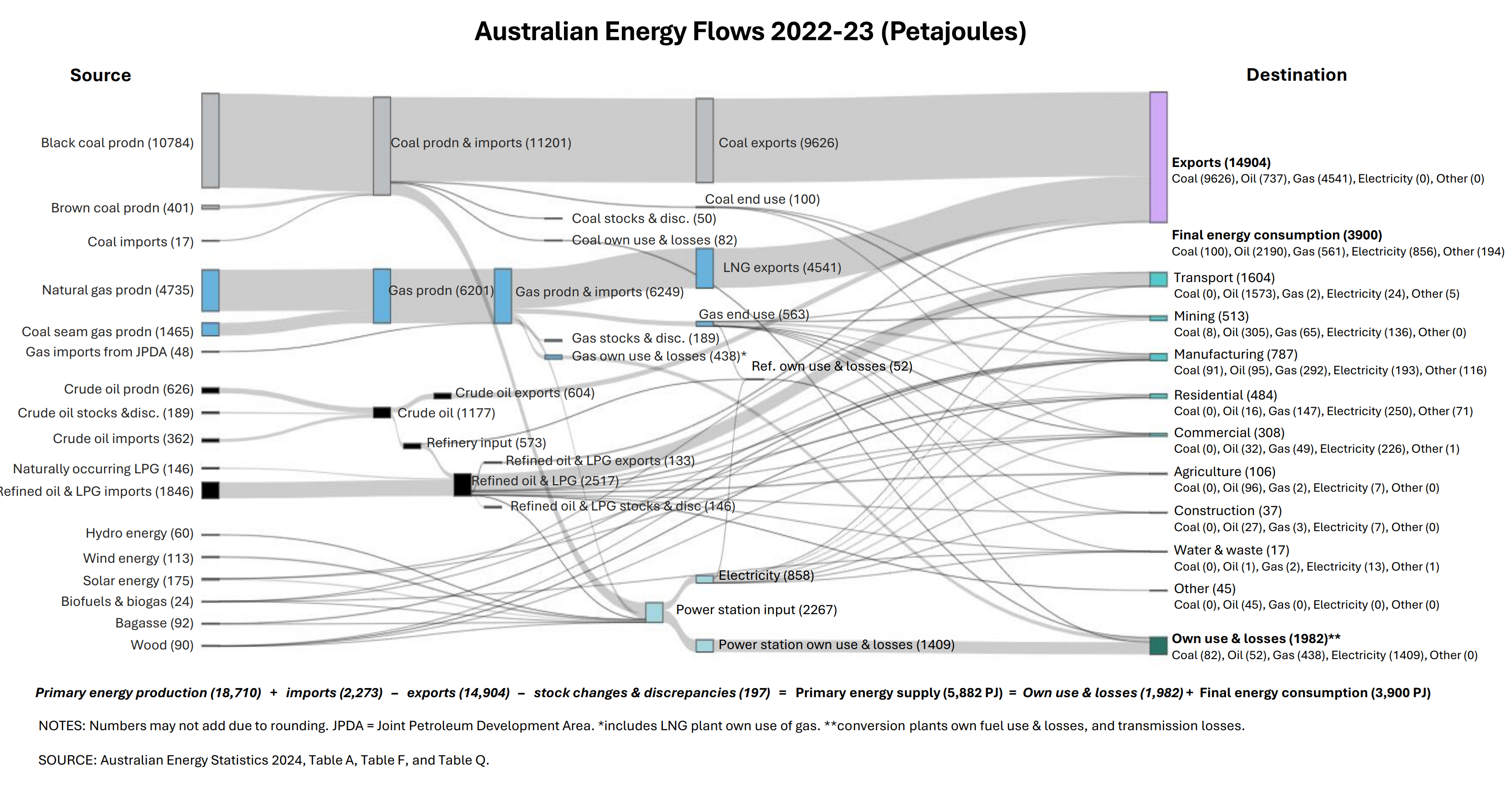
Western Australia’s gas offers a practical near-term energy source for this industry, though competitive pricing is crucial. Longer-term, Perth’s solar potential and nuclear power are vital. The required 4,125 PJ translates to a continuous power output of 131 GW, significantly exceeding Australia’s current ~60 GW generation capacity.
Importantly, an output of 275 million tonnes of steel would make Australia the second largest producer, behind China’s massive output (over 1000 million tonnes annually), and above India (140), the US and Russia (75), South Korea (67), and Germany (35).
Learning from the Fall of an Industry
Remember when we made cars? I do, because I remember fellow engineering grads getting jobs at Holden and Ford. I remember a friend working at a company in Adelaide that produced car wing mirrors. It’s all gone. All the jobs, all the suppliers, all of that economy is gone.
We stopped making cars because cheaper alternatives from Japan, South Korea, and China flooded our market. While low-cost imports seemed great, in time, they decimated our local manufacturing base. It was a sugar high. It’s not that having cheaper options is inherently bad; it’s that over-relying on them can damage our industrial economy. We didn’t just lose the cars; we lost the entire network of design, engineering, and innovation that forms the backbone of an strong country.
Sensible policies - targeted tariffs on imported cars paired with incentives for local production - could have protected this. This isn’t nostalgia; it’s a lesson for every industry.
To be rich, we must create and sustain our own manufacturing ability.
Building Supplies
Ask yourself: why are Australian homes often reliant on imported materials, even seemingly basic ones like timber, when we have the ability to produce our own abundant cheap steel and grow our own timber?
Our reliance on a complex set of imported building supplies reveals another glaring misstep. While Australia is largely self-sufficient in softwood timber for framing, we import significant quantities of hardwood and, crucially, a large proportion of items like ceramic tiles, glass, plumbing fixtures, and many electrical components. The reliance on imported plywood is a perfect example, surging at times due to high demand.
The answer is not just to be self-sufficient. It needs to be economically self-sufficient. It is to invest in domestic capabilities - in areas that make sense, like Tasmania, Victoria, and South Australia for timber - and in modern processing facilities that make advanced building materials. Cross-laminated timber, high-grade plywood, engineered flooring. A robust local industry can stabilise the construction supply chain. Paired with affordable steel, this is how we build homes for Australians. The key is competitiveness, not just presence. We must acknowledge that even with local production, global market forces will always play a role.
Power Paradox
Australia faces a perplexing energy paradox, but it’s even more acute than simply high prices amidst resource wealth. While we congratulate ourselves on renewable energy targets and household solar uptake, we’ve dangerously narrowed our focus to generating just enough green power to keep the lights on in our homes. In this pursuit, we’ve seemingly lost sight of a fundamental truth: competitive manufacturing demands the world’s cheapest power, not just green power.
We export vast quantities of coal and gas, resources that could be fueling our own industrial revolution, yet our domestic energy prices remain cripplingly high for businesses. This isn’t just a paradox; it’s a strategic misstep with dire consequences. We’ve become fixated on the volume of renewable energy for households, while neglecting the critical cost and scale of energy required to power heavy industry.
The political discourse around net-zero, while important for global emissions reduction, has become dangerously myopic. We risk celebrating symbolic victories in household renewable adoption while simultaneously dismantling our industrial base. The reality is stark: without access to the world’s cheapest energy, we cannot competitively manufacture anything of substance. And without manufacturing, a resource-rich nation like Australia risks becoming poor – a quarry for the world, not a prosperous, self-reliant economy. True environmentalism must also be about securing a sustainable economic future, and that future is inextricably linked to affordable, abundant energy for industry.
The Currency Trap
The wild fluctuations of the Australian dollar have highlighted how dependent we are on imports. Every swing in the currency leaves our builders, manufacturers, and consumers at the mercy of global markets - raising costs unpredictably and undermining economic stability.
When we build with materials from abroad, we cede a degree of control over our economic destiny. By investing in domestic production - from refining our vast iron ore reserves into steel, to competitively manufacturing engineered wood, to building ships - Australia can increase its resilience to international market changes.
Creating greater self-reliance is not simply a matter of pride; it is a strategic necessity.
A National Call to Build for Ourselves
At its heart, the question “Why should Australia be rich?” challenges us.
What are we building for the world?
Our natural resources, our geographic advantages, and our existing industrial know-how can propel us into an era of unprecedented prosperity - if we take step 3.
Step 3: Refine and manufacture products with these materials, and then sell them, to everyone.
We’ve got to cut the short-term sugar high of cheap imports where domestic production is strategically important and instead, we must build for ourselves.
Here’s the blueprint:
- Energy Independence and Cost Reduction:
- Immediate Action: Utilize existing coal and gas resources, particularly in resource-rich areas like Western Australia, to provide immediate, low-cost power for industrial development. This is a transitional strategy to ‘kick-start’ manufacturing.
- Long-Term Investment: Aggressively invest in nuclear power as a clean, reliable, and long-term energy solution
- Incentivize Domestic Refining and Manufacturing:
- Export Taxes: Implement a tiered tax system on the export of unrefined minerals. The less processed the material, the higher the tax. This strongly encourages domestic value-add
- Manufacturing Grants: Use the revenue generated from export taxes and import tariffs primarily to fund grants and incentives for companies investing in local manufacturing, processing, and value-adding of raw materials. These grants should prefer projects that create high-skill jobs and use advanced technologies, like robotics and AI.
- Energy as a Priority: A significant portion of the funding raised should be directly invested in energy infrastructure – both the immediate expansion of gas/coal-fired power in strategic locations (like Perth) and the accelerated development of nuclear power plants. The explicit goal is to achieve dramatically lower energy costs across the entire economy, making Australian manufacturing inherently more competitive.
Australia’s wealth is not an accident - it’s designed in the way we harness, process, and create value. To be rich is to make things of value, and to do so competitively. It’s time to transform our 36% share of global iron ore production into a robust domestic manufacturing revolution.
Let’s make Australia a nation that makes things – a future where our resources power our own industries, where we build for ourselves, and where economic prosperity is secured through strategic policy and a commitment to adding value at every stage.
Let’s build an Australia that stands tall, resilient, and unquestionably rich.